09 Feb 2026
In many critical network environments, reporting is still a polite word for manual labour. We have all seen it happen; A technician exports a CSV from the NMS, spends three hours wrestling with a spreadsheet, and manually cross-references it with a maintenance log, all whilst hoping no one made a typo. It is slow, it is prone to human error, and frankly, it does not scale.
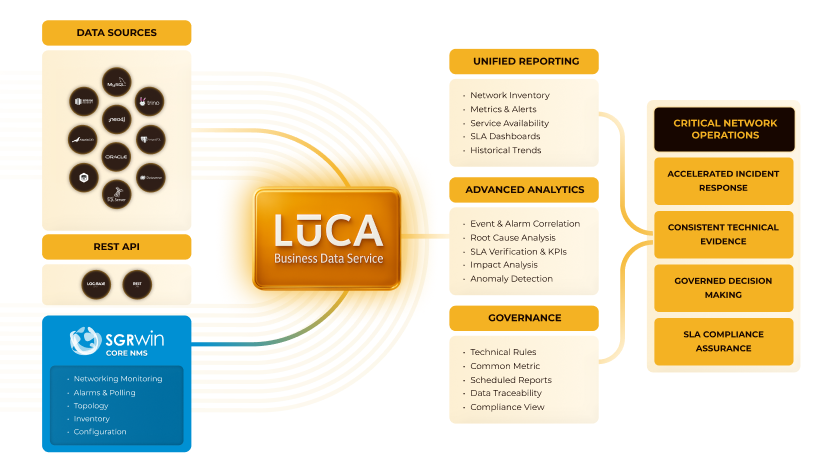
If your network grows by 20 per cent, your reporting workload grows by 20 per cent. That is a recipe for burnout. LUCA BDS, SGRwin’s business intelligence addon, changes the game by moving the intelligence inside the system. It transforms standard NMS activity into reliable technical evidence for managing critical telecommunications networks.
Limitations of traditional NMS in monitoring critical networks
A classic NMS is built to watch devices and events, but in a critical network, truly understanding the service requires much more. You need a clear view of network inventory, configuration changes, operational tickets, and maintenance windows.
When this information stays scattered, your reporting is always going to be incomplete. You might detect an event, but finding the root cause still requires slow, manual analysis. You end up guessing the impact on the service rather than knowing it, which means your traceability is neither direct nor reproducible.
LUCA BDS fixes this by consolidating your reporting within the SGRwin environment. It correlates events with their operational context so you get a consistent technical view of your service status, whether you are in the middle of an operation or performing a post-event analysis.
The Challenge of Standardising Technical Metrics in Critical Networks
Critical infrastructures generate a massive volume of events, and between repetitive alarms and false positives, the “operational noise” can be deafening. This lack of prioritisation makes it difficult to provide a high-quality technical response when it actually matters.
Without consistent criteria, your monitoring metrics lose their value. If different teams apply their own interpretations to the same data, reports become impossible to compare and confidence in your indicators starts to crumble.
LUCA BDS introduces a standardised reporting model for your NMS that is based on common rules and focused on service impact. By aligning metrics with technical SLAs and KPIs, your data remains consistent over time, allowing for proper, comparable analysis across different periods and teams.
Operational Scalability and the End of Manual Reporting
In many critical network environments, reporting is treated as something external to the NMS, built on a shaky foundation of exports and manual adjustments. This approach fragments your information, introduces errors, and makes it impossible to scale as your network or audit requirements grow.
LUCA BDS changes the game by integrating information generation directly into SGRwin, which completely removes the need for external processing. Reports are built on defined, governed models with full traceability. This allows your operational knowledge to move out of one person’s head and into the monitoring system itself.
The result is an operation that is scalable by design. You get consistent, reusable technical information that is ready for decision-making in environments where data reliability is just as important as event detection.
From Reaction to Informed Decision-Making in Critical Networks
Traditional monitoring does not fail because it misses a detection. It fails because it does not provide governed information that you can actually use to make a decision. Without this layer, your NMS is stuck reacting to events rather than offering a foundation to prioritise or justify service improvements.
The integration of SGRwin with LUCA BDS transforms monitoring into a strategic, decision-oriented tool. Your analysis becomes consistent, traceable, and perfectly aligned with your operational management. In critical environments, this facilitates the move from simple observability to a strategic domain, ensuring every decision you make is based on reliable data.
Are your infrastructures prepared for a future where the ability to make rigorous decisions will be the decisive factor for your business? Let´s talk!